
When buying a corset, harness or body belt online, a beautiful photo does not yet guarantee that the product will fit comfortably. Leather and straps are often firmer and less stretchy than textile, so accurate measurements are the most important step before placing an order. If you are between sizes or unsure how a specific model should fit your body – it is better to consult than to guess.
Šiame gide rasite instrukciją, kaip teisingai išmatuoti savo kūną, kad užsakytas gaminys tiktų idealiai.
How to Measure Correctly
What You Need for Measurements
- A soft measuring tape (not a construction tape measure).
- A mirror or a partner to help check that the tape is straight.
- Thin clothing / underwear (ideally – without thick seams and "push-up").
- Paper / phone to write down the results.
General Rules
- Do not compress the skin. The tape should fit snugly, but should not "dig in".
- Do not leave it loose. If the tape slides around, the measurement will be too large.
- Measure after a calm exhale. Do not breathe in with a "full chest" and do not suck in your stomach.
- Repeat 2–3 times. If the numbers differ – measure again and take the average.
- Write down in centimetres. Ideally – without rounding, but if needed: round to 0.5 cm.
Main Measurements
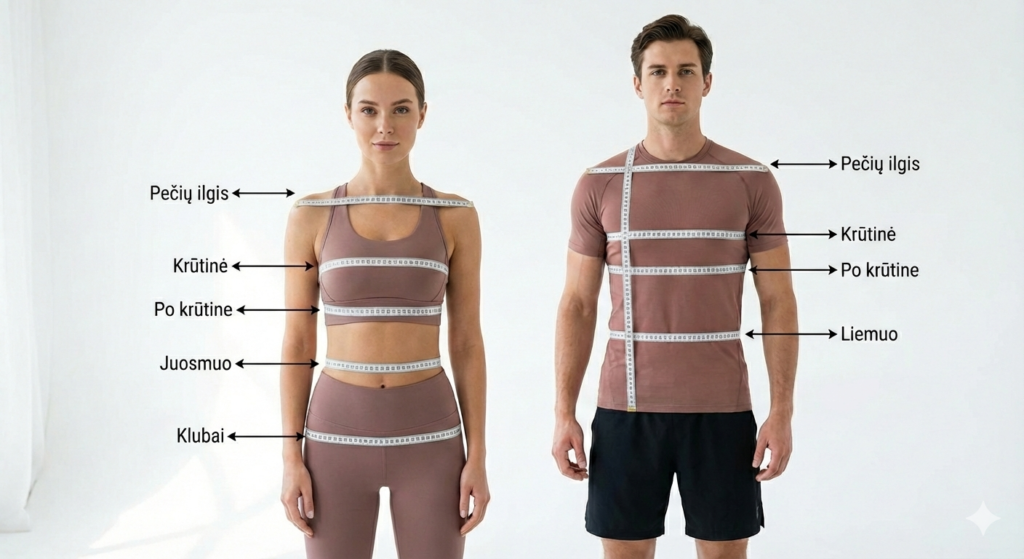
1) Chest circumference (across the fullest point)
How to measure: tape across the fullest part of the chest, straight across the back. Arms down, posture natural.
Common mistake: measuring too high (near the armpits) or while wearing a bra that strongly lifts/changes the shape.
2) Underbust circumference (band)
How to measure: the tape goes where the breasts end (under the bust), which is where the bra underwire usually sits.
Common mistake: the tape "slides down" onto the waist or rides up too high onto the chest.
3) Waist circumference (narrowest point)
How to measure: find the narrowest point on your sides. A simple trick: stand straight and gently bend to the side – a crease will form, and the waist is usually right there.
Common mistake: the waist is measured too low (where the waistband of trousers sits).
4) Hip circumference
How to measure: this is the point where trousers and a belt usually fasten, in other words at the hip bones.
Common mistake: measuring too high or across the fuller part of the hips.
5) Shoulder width (shoulder to shoulder)
How to measure: Stand straight, arms down. Find the "shoulder point" – the point where the shoulder meets the arm. Measure across the back from one shoulder point to the other, keeping the tape straight (not diagonal).
Common mistake: Measuring across the front (across the chest), taking points too close to the neck, or the tape running diagonally down across the back.
6) Vertical length from shoulder to waist (shoulder to waist)
How to measure: Find the waist line (where the waistband of trousers usually sits). Then measure vertically downward from the shoulder to the waist line.
Common mistake: Measuring from the shoulder point, leading the tape diagonally – the tape must run straight.
Women (XS–XL) – reference measurements (cm)
| Dydis | Krūtinė (cm) | Liemuo (cm) | Klubai (cm) |
|---|---|---|---|
| XS | 78–82 | 60–64 | 86–90 |
| S | 83–87 | 65–69 | 91–95 |
| M | 88–92 | 70–74 | 96–100 |
| L | 93–99 | 75–81 | 101–107 |
| XL | 100–106 | 82–88 | 108–114 |
Men (XS–XL) – reference measurements (cm)
| Dydis | Krūtinė (cm) | Liemuo (cm) | Klubai (cm) |
|---|---|---|---|
| XS | 86–91 | 71–76 | 86–91 |
| S | 92–97 | 77–82 | 92–97 |
| M | 98–103 | 83–88 | 98–103 |
| L | 104–109 | 89–94 | 104–109 |
| XL | 110–115 | 95–100 | 110–115 |